Summary: I2C Issue and Fix
The Problem
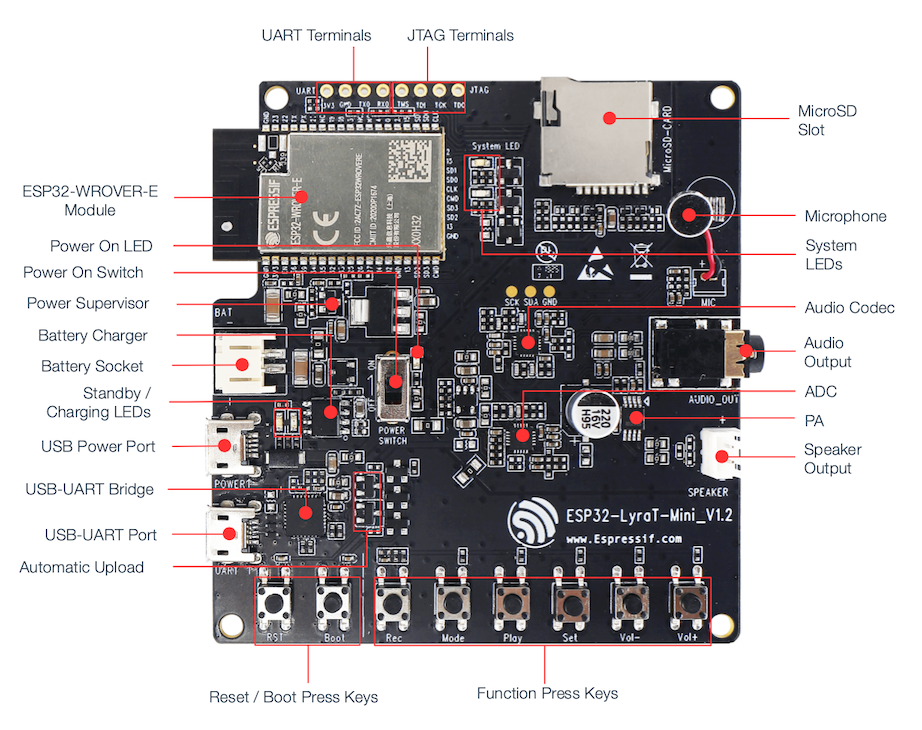
The MCP23017 I/O expander (for the keypad) and the ES8311 audio codec both needed to share the same I2C bus (GPIO 18/23) on the LyraT Mini board.
What We Discovered
MCP23017 worked perfectly BEFORE audio_board_init() using the native ESP-IDF I2C driver
After audio_board_init(), using ESP-ADF's i2c_bus_read_bytes/i2c_bus_write_bytes gave garbage data (always read 0xB2 regardless of what was written)
Root Cause
We dug into ESP-ADF's i2c_bus_v2.c and found the bug on line 92:
.device_address = addr >> 1, // ESP-ADF shifts the address RIGHT
ESP-ADF expects an 8-bit I2C address (left-shifted with R/W bit), but we were passing a 7-bit address (0x21). So:
We passed: 0x21
ESP-ADF calculated: 0x21 >> 1 = 0x10 (WRONG device!)
The Solution
We found that ESP-ADF exposes i2c_bus_get_master_handle(port) which returns the native i2c_master_bus_handle_t.
The fix:
Let audio_board_init() create the I2C bus normally
Get the native handle: i2c_bus_get_master_handle(I2C_NUM_0)
Add MCP23017 using native API: i2c_master_bus_add_device(bus, &cfg, &mcp23017_dev)
Use native functions: i2c_master_transmit() / i2c_master_receive()
This allows both the audio codec (via ESP-ADF) and MCP23017 (via native driver) to share the same I2C bus without conflicts, each using their preferred API.
We are writing our own code - not using the UncleRus library.
We initially attempted to integrate the UncleRus mcp23x17 component, but it caused conflicts with ESP-ADF's i2c_bus library (both tried to manage the I2C bus, leading to crashes).
Our current implementation is minimal custom code:
Code: Select all
// MCP23017 device handle (native ESP-IDF)
static i2c_master_dev_handle_t mcp23017_dev = NULL;
// Simple register write
static esp_err_t mcp23017_write_reg(uint8_t reg, uint8_t value)
{
uint8_t data[2] = {reg, value};
return i2c_master_transmit(mcp23017_dev, data, 2, 100);
}
// Simple register read
static esp_err_t mcp23017_read_reg(uint8_t reg, uint8_t *value)
{
esp_err_t err = i2c_master_transmit(mcp23017_dev, ®, 1, 100);
if (err != ESP_OK) return err;
return i2c_master_receive(mcp23017_dev, value, 1, 100);
}
This is just ~20 lines of code that directly uses the native ESP-IDF I2C master API, which integrates cleanly with ESP-ADF's audio board without any library conflicts.
Here's how mcp23017_dev is initialized in mcp23017_init():
Code: Select all
static esp_err_t mcp23017_init(void)
{
    // Step 1: Get the native I2C bus handle from ESP-ADF
    // (audio_board_init already created this bus for the codec)
    i2c_master_bus_handle_t bus = i2c_bus_get_master_handle(I2C_NUM_0);

    // Step 2: Configure the MCP23017 device
    i2c_device_config_t dev_cfg = {
        .dev_addr_length = I2C_ADDR_BIT_LEN_7,
        .device_address = MCP23017_ADDR,  // 0x21 (7-bit address)
        .scl_speed_hz = 100000,           // 100 kHz
    };

    // Step 3: Add device to the bus - this creates the device handle
    esp_err_t err = i2c_master_bus_add_device(bus, &dev_cfg, &mcp23017_dev);

    // Step 4: Configure MCP23017 registers for keypad
    mcp23017_write_reg(MCP23017_IODIRA, 0xF0);  // GPA0-3 outputs, GPA4-7 inputs
    mcp23017_write_reg(MCP23017_GPPUA, 0xF0);   // Pull-ups on inputs
    mcp23017_write_reg(MCP23017_OLATA, 0x0F);   // Columns HIGH initially
    ...
}
The key insight is:
i2c_bus_get_master_handle(I2C_NUM_0) - ESP-ADF function that returns the native bus handle created by audio_board_init()
i2c_master_bus_add_device() - Native ESP-IDF function that adds our MCP23017 to the existing bus and gives us a device handle
This way we "piggyback" on the I2C bus that the audio board already created, rather than trying to create our own conflicting bus.
 SCK is not the same as SCL
 SCK = I²S Bit Clock (BCLK)
 SCK ≠ I²C Clock (SCL)